Advanced Grammar
Mastering Conditional Sentences: Zero to Third
Published · Updated · 3 min read
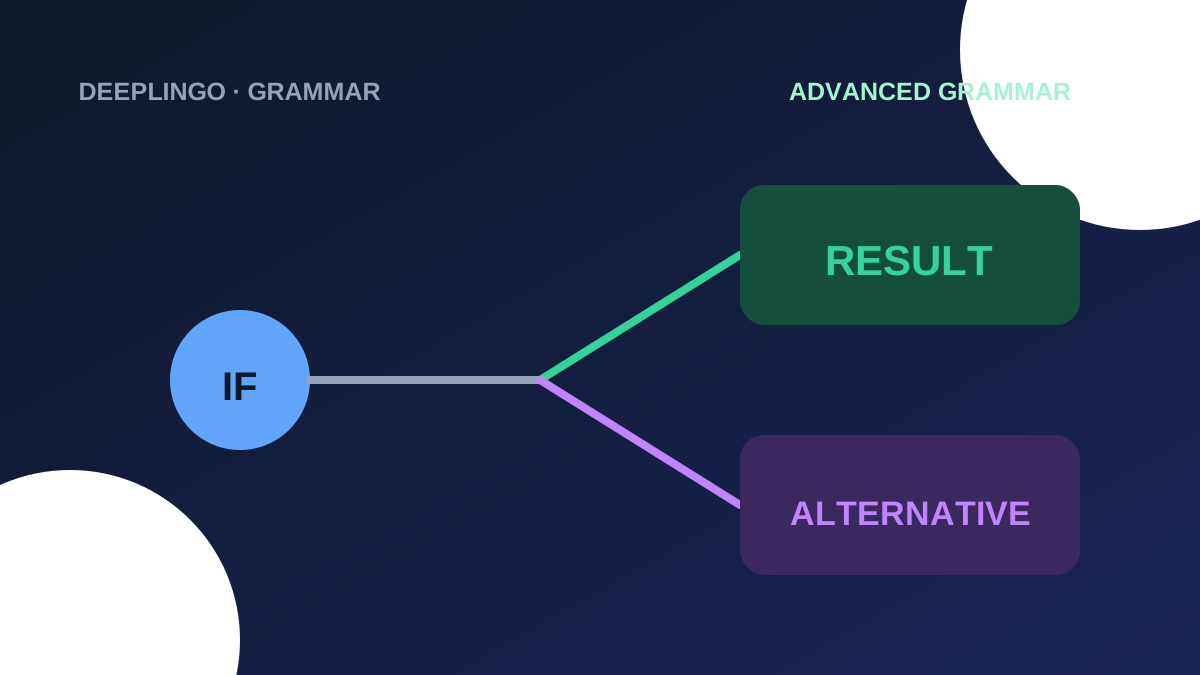
Conditional sentences connect a condition with a result. The verb forms help express general situations, real possibilities or hypothetical alternatives.
Conditional sentences connect a condition with its result. The four common patterns help us talk about general results, possible futures and imagined situations. They show how the speaker views a situation; they do not give it a fixed probability.
Zero Conditional: General and Repeated Results
Use this for general facts, regular results and habits. The result usually or regularly follows the condition.
Formula: If + present simple, present simple
If you heat water to its boiling point, it boils.
💡 A general result under the right conditions.
If it rains, the ground usually gets wet.
💡 A typical result, though not in every situation.
If you mix red and blue paint, you usually get purple.
💡 A general result when mixing these paint colors.
First Conditional: Real Possibilities
Use this for a possible or likely future condition and its result. The context tells us how likely the speaker thinks it is.
Formula: If + present simple, will + base verb
If it rains tomorrow, I will take an umbrella.
💡 Real possibility - might rain!
If you study hard, you will pass the exam.
💡 Likely result of studying
If she calls, I will answer.
💡 Real future possibility
Second Conditional: Imagined Present or Future
Use this to imagine a different present or future. Compared with the first conditional, it often presents the situation as less likely, but it does not always mean impossible.
Formula: If + past simple, would + base verb
If I had wings, I would fly to school.
💡 Imaginary - I don't have wings!
If I won the lottery, I would buy a house.
💡 An imagined future situation and result.
If I were you, I would study more.
💡 Giving advice (use "were" for all subjects)
Third Conditional: Imagining a Different Past
Use this to imagine a different past condition and result. It can express regret, give an explanation or simply explore what might have happened.
Formula: If + past perfect, would have + past participle
If I had studied, I would have passed.
💡 Regret: I didn't study, so I didn't pass
If she had left earlier, she would have caught the bus.
💡 She didn't leave early, missed the bus
If they had invited me, I would have come.
💡 They didn't invite me, so I didn't come
Quick Summary Table
| Type | If Clause | Result Clause | Used For |
|---|---|---|---|
| Zero | Present Simple | Present Simple | General facts, regular results |
| First | Present Simple | Will + verb | Real future possibilities |
| Second | Past Simple | Would + verb | Imagined present or future |
| Third | Past Perfect | Would have + past participle | Imagined past result |
Continue learning
Future Simple with Will: Rules and Examples · Past Perfect: Rules and Examples
Practice in the 30 Days English Challenge: Day 8: Would, Should, Could and Might: Uses and Examples · Day 22: English Conjunctions: Connect Ideas with And, But and Because · Day 28: English Conditionals: Real and Imagined Situations